Selecting a course
We are offering four 447 options in Winter 2025/2026. Each of the 5 seminars will cover different topics. Details about topics will be released in June.
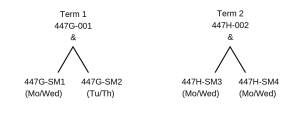
These 447 courses are classified under 447G-001 (term 1) and 447H-002 (term 2), with two seminars for term 1 (447G-SM1, 447G-SM2) and three seminars for term 2 (447H-SM3, 447H-SM4).
In order to register for a 447 class, please first select your term (447G-001 or 447H-002) and then choose which corresponding seminar (SM1, SM2, SM3, or SM4) you would like to take. You must enroll in both a section (G/H) AND a seminar section (1/2/3/4).
For example, a student could choose to enroll in 447G-001 and 447G-SM1. This is similar to the process of selecting a course section and then choosing a corresponding tutorial.
Current course offerings
Discover the current LING 447 courses offered by the Department of Linguistics for the 2025W academic year.
Term 1
The Cross-Linguistic Semantics and Pragmatics of Polar Questions
Course #: LING 447G-SM1
Days/times: Mon/Wed 2:00-3:30pm
Instructor: Lisa Matthewson
Prerequisites: LING 201
Description:
In this course we investigate the semantics and pragmatics of polar questions (questions that invite a ‘yes’ or ‘no’ response). Many languages have more than one way to ask a polar question, which have distinct pragmatic effects. In English, for example, the questions in (1) are appropriate in different discourse contexts. See this blog post for more examples.
(1) a. Did Pam leave?
b. Didn't Pam leave?
c. Pam left?
d. Pam left, didn't she?
e. Did Pam leave or not?
The course will take a cross-linguistic approach to the study of polar questions. We will concentrate in part on languages the students natively speak, or languages they have access to speakers of. Students will read primary literature, work on their own mini research projects, and participate in a joint class research project.
How to register for this course:
-
- First, register for LING 447G 001 (Lecture)
- Next, register for LING 447G SM1 (Seminar)
Structure of Wá∙šiw
Course #: LING 447G-SM2
Days/times: Tues/Thurs 9:30am-11:00am
Instructor: Ryan Bochnak
Prerequisites: LING 200, 201, and one of LING 300, 311, or 327
Description:
This course is an introduction to the linguistic structures of Wá∙šiw (a.k.a. Washo, Washoe), an endangered Indigenous language isolate of northern California and Nevada. We will examine various topics in phonology, morphology, syntax, and semantics. Throughout the course, Wá∙šiw data will be discussed in their relevant theoretical, social and historical contexts through lectures and readings. Students will have the opportunity to engage with a variety of language materials, including audio recordings, published texts, research papers, and field notes. Students will also gain some practical familiarity with the language and develop some basic conversational skills.
By the end of the course, students should be able to:
– describe linguistic patterns of the Wá∙šiw language
– describe similarities and differences between Wá∙šiw and English (and other familiar languages)
– read philological and linguistics papers on topics in the analysis of Wá∙šiw
– perform morphological analysis of Wá∙šiw texts
– contribute to community-based language preservation initiatives by developing pedagogical materials for use in Wá∙šiw language learning contexts
How to register for this course:
-
- First, register for LING 447G 001 (Lecture)
- Next, register for LING 447G SM2 (Seminar)
Term 2
Movement in Sociophonetics
Course #: LING 447H-SM3
Days/times: Mon/Wed 11:30am-1:00pm
Instructor: Amanda Cardoso
Prerequisites: LING 200 and LING 313
Description:
Through Sociophonetics and Sociophonology, we will explore movement in sociolinguistic theory, methodological movements, and social movement. Specifically, the course will address intersectionality and what that means for research and language work in sociophonetics. We will also discuss the most recent advances in acoustic (spoken) and optical (sign) analysis of language production and perception of language. Finally, we will explore how social movements relate to language change, such as in cases of immigration and taboo avoidance.
How to register for this course:
-
- First, register for LING 447H 002 (Lecture)
- Next, register for LING 447H SM3 (Seminar)
From Posture to Production: Articulatory Settings in Speech
Course #: LING 447H-SM4
Days/times: Mon/Wed 11:30am-1:00pm
Instructor: Jahurul Islam
Prerequisites: LING 314 or LING 313
Description:
Languages exhibit systematic differences in the phonetic behavior of speech sounds. This course examines cross-linguistic articulatory settings, the characteristic postures and movement tendencies of the vocal tract that speakers bring into speech production based on their language background. Emphasizing articulatory approaches, the course explores how these settings shape speech production patterns within and across languages. A key focus will be on how bilingual and multilingual speakers manage, adapt, or blend articulatory settings across their languages. Course activities will be student-led, featuring hands-on discussions, presentations, and engagement with experimental studies using articulatory methods (e.g., ultrasound, MRI, video, EMG) and acoustic analyses to describe cross-linguistic patterns. As part of the course, students will collaborating in small teams to work on a Capstone Project, completing a full cycle of a research project, progressing through, hypothesis formation, study design, data collection and analysis, and writing a pre-publication manuscript.
How to register for this course:
-
- First, register for LING 447H 002 (Lecture)
- Next, register for LING 447H SM4 (Seminar)